

Evidence Standard
The Evidence Standard defines how governance claims are supported through attributable, contemporaneous, and system-generated evidence.
1. Purpose of Governance Evidence
Section titled “1. Purpose of Governance Evidence”Governance evidence exists to demonstrate accountability.
For consequential decisions produced by autonomous systems, evidence records must allow institutions to answer three questions from contemporaneous records: who was responsible, what did they know, and what did they do.
2. Evidence Categories
Section titled “2. Evidence Categories”ARAF evidence programs evaluate governance posture across four categories:
- Design Evidence
- Deployment Evidence
- Operational Evidence
- Outcome Evidence
Coverage across all four categories is required to support reconstructability.
3. Evidence Quality Requirements
Section titled “3. Evidence Quality Requirements”Evidence used for governance assessment must satisfy four quality requirements:
- Authenticity
- Integrity
- Traceability
- Exportability
These requirements determine whether evidence can be independently relied upon by boards, insurers, investors, regulators, and assessors.
4. Evidence Tiers
Section titled “4. Evidence Tiers”ARAF classifies governance evidence into four quality tiers.
| Tier | Evidence Type | Core Characteristics |
|---|---|---|
| Tier 1 | Infrastructure-generated evidence | Contemporaneous, system-generated, and tamper-evident records produced directly by governance enforcement infrastructure (for example decision logs, enforcement actions, override and exception logs, drift outputs). |
| Tier 2 | Contemporaneous documentation | Records created at the time of governance activity but not directly generated by technical enforcement infrastructure (for example governance meeting records, approvals, escalation logs, manual review records). |
| Tier 3 | Reconstructed documentation | Records assembled retrospectively from available artefacts after the relevant governance activity occurred. |
| Tier 4 | Management representation | Formal written representation where no contemporaneous record exists. |
5. Admissibility by Certification Tier
Section titled “5. Admissibility by Certification Tier”| Certification Tier | Tier 1 | Tier 2 | Tier 3 | Tier 4 |
|---|---|---|---|---|
| ARAF Assessed | Admissible | Admissible | Admissible with explicit qualification | Not admissible as primary evidence |
| ARAF Compliant | Required where structurally available | Admissible where Tier 1 is structurally unavailable | Not admissible for coherence determination | Not admissible |
| ARAF Certified | Required for at least 80% of sampled controls | Limited use where Tier 1 is structurally unavailable and no unresolved significant findings remain | Not admissible | Not admissible |
If Tier 4 is the only available source for a control, the control must be assessed as not evidenced and the finding recorded accordingly.
6. Evidence Continuity Across the Decision Supply Chain
Section titled “6. Evidence Continuity Across the Decision Supply Chain”Autonomous outcomes are produced through a distributed Decision Supply Chain involving systems, human actors, and execution infrastructure. Governance evidence must follow the decision through each link in the chain.
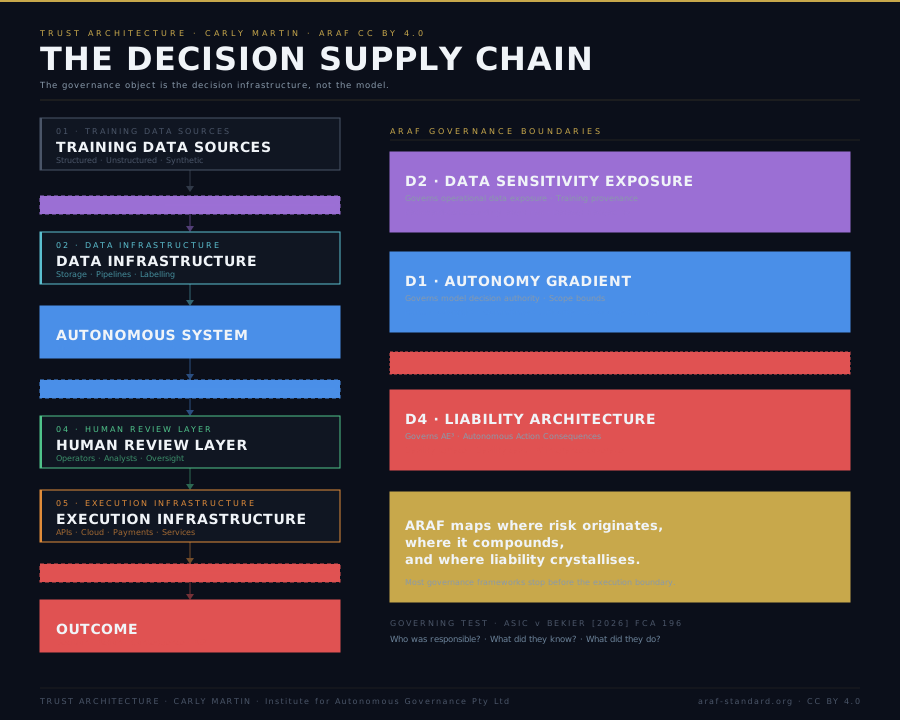
A record that captures one link but omits upstream or downstream links is chain-incomplete and does not satisfy reconstructability requirements.
7. Evidence Infrastructure Certification
Section titled “7. Evidence Infrastructure Certification”Governance infrastructure platforms may seek Evidence Infrastructure Certification to demonstrate that their telemetry outputs satisfy the evidentiary requirements of authenticity, integrity, traceability, and exportability.
For a detailed implementation specification of governance records architecture, see EIS-01. This standard defines the minimum structure of a compliant Tier 1 governance decision record under ARAF, including requirements for reconstructability, authority, and integrity.
// …existing code…
8. Coherence Assessment Window
Section titled “8. Coherence Assessment Window”For Compliant and Certified determinations, evidence must be sampled across the full operational coherence assessment window. The minimum window is 180 days, and the report must specify the exact window assessed.
See also
Section titled “See also”- Assessment Preparation Guide
- Certification Framework
- ARAF Standard v3.0, Clause 8
- Evidence Infrastructure
- ARAF Assessor Accreditation Standard
Citation
Martin, Carly. Agentic Risk Architecture Framework (ARAF), Version 3.0. Institute for Autonomous Governance Pty Ltd, 2026.